"I don't know what your destiny will be, but one thing I know: the only ones among you
who will be really happy are those who will have sought and found how to serve" Albert Schweitzer

Friday, September 3, 2010

7 Days In Haiti

In the immediate aftermath of the catastrophic earthquake that struck Haiti, Tim Scott and Will Decker of Travel the Road, enter the capital of Port-Au-Prince to find a city in chaos. Their mission, to find hope amidst this tragedy, brings them to the downtown district where they witness the miraculous rescue of a man trapped beneath rubble for 15-days, without food or water. But soon after, violence erupts when rogue Haitian police begin shooting civilians for scavenging. Street riots, gunfights and civil unrest threaten to tear apart the city, and when all hope seems lost Tim and Will make contact with local believers who show them the power of the human spirit and an unshakeable faith for a better future. 

Wednesday, September 1, 2010

Terry's Haiti Journal - August, 2010

Aug 20 - The Thedacare Orthopedics Plus Haiti Relief team from Appleton Wisconsin is locked and loaded. The team:
1. Todd Smith (Orthopedic surgeon)
2. Terry Dietrich (Orthopedic surgeon)
3. Jeannie Dietrich (RN/Trip coordinator)
4. Jodi Zimmerman (RN)
5. Becky Czechanski (RPT)
6. Kristen Daniels (RTRM)
7. Hannan (RTRM)
8. Trent Jerzinski (Health Care engineering/construction specialist)
9. Ed Mueller (Linvatec representative/arthroscopy equipment specialist)
We have included a wound specialist, JanKlass, from San Diego as well as an anesthesiologist, Karl Eckhardt, from Walla Walla, Washington. Both are high priority for the types of patients that are cared for at the Hopitale Adventiste d’Haiti.
This team was formed to respond to the orthopedic needs of the people of Haiti in the aftermath of the devastating earthquake of January 12. The site for our work will be the HAH. This small mission hospital in a suburb of Port as Prince was developed in the weeks following the earthquake to care for the many patients with fractures and other orthopedic injuries. Dr Scott Nelson was the first orthopedic surgeon to arrive in the city just 24 hours after the earthquake. He decided after assessing the medical facilities to focus on HAH as the best site to provide orthopedic care. No orthopedic surgery had ever been done at HAH before the earthquake. In the past 7 months, he has done a remarkable job of developing the orthopedic capabilities of HAH. It is now regarded as THE referral hospital for orthopedics in the entire country. Many of the patients that are cared for there are victims of the earthquake with residual infections and/or deformities that were unable to be treated in the chaos following the disaster. Many patients with orthopedic injuries that have occurred since the earthquake are now also treated at HAH.
The goals of the team are:
1. Provide orthopedic care for Haitians
2. Develop an arthroscopy capability for HAH (the first such program in the country)
3. Assess the physical needs of the hospital. 
4. Develop strategies for raising funds to support costs of providing orthopedic care for indigents.
Dr Nelson and other volunteer orthopedists have been inundated with orthopedic cases especially in the indigent population. There is a huge ongoing need for volunteers to continue to provide this care. The government orthopedic hospital is largely limited to treating the patients with acute trauma. Their resources are limited. Arthroscopy will increase the range of orthopedic services and bring a modern orthopedic capability to the country. The Hospital physical plant has major needs. The operating rooms are very small making it difficult to accommodate the equipment necessary for modern orthopedics. Storage space is hopelessly inadequate.
All team members plan to spend the night near the airport in Chicago. We leave at 9:20 tomorrow.
Aug 21 - The trip to Haiti had some anxious moments. We arrived at the airport before 7 am. We were informed that the maximum number of checked bags per person is 2. The Website indicated 3. We were able to repack and use the overweight allowance of 70# for 3 of our bags. We had a very helpful AA desk agent named Eli Ortega. Jan met us in Miami. Karl arrived in Port au Prince yesterday. There were 3 other AA planes on the tarmac when we touched down. Baggage claim was near total chaos. All of our luggage made it in good condition. The hospital contact got us to the vehicles and secured the luggage. It was a fairly long walk. On our trip through the city, it appeared as if there has been virtually no work done to remove the rubble or rebuild. It really leaves an impact to see the incredible amount of destruction in the city and the piles of rubbish and the tens of thousands of tents. We met with Nathan and Amy at the hospital and gave the group an orientation. We are anxious to start seeing patients and putting our new equipment together and start using it.
Aug 22 - The forecast was for a light day. We started with morning report at 7:30. We just finished our last case n the OR and it is 10 pm. We have 6 cases on the schedule tomorrow including a man who came in to the ER with fractures of the tibia, femur and proximal humerus. The C-arm gave us grief today and wouldn’t boot up. We are hoping we can get it figured out by tomorrow. Ed got all of the arthroscopy equipment unpacked and is anxious to start using it. Ben scrubbed in on some cases and was a big help. The whole team has jumped in with both feet. It is a great team to be a part of.
Aug 23 - As expected, the ortho clinic was huge. Scott managed it pretty much by himself while Todd started the first case in the OR. I made rounds with the rest of the team. Our patients are doing well except for the patient with the multiple fractures. His hemoglobin was 6.0. We asked for blood and are still waiting. Meanwhile, his Hgb has dropped to 4.7. Since malunions and nonunions are treatable, we have decided to not operate until blood is available. We did a lot of cases today and finished by 8:30. They all went well even though we don’t have a C-arm to check our reductions. We might have to make some adjustments to some of the fractures. We ran 2 rooms a good share of the day. It is great to have 2 anesthesiologists. Jeannie has been spending a lot of time with Lucia learning how to set up the OR and how everything is organized. We used the new drill/pin driver on 2 cases today and it works great. Ed scrubbed in and assisted Todd on an ORIF of an elbow fracture. Ben helped me on several cases. It is really fun working with these guys. Trent made contact today with the Haitian student. I don’t know what happened with that yet. I am sure that tomorrow will bring more new challenges.
Aug 24 - The ortho clinic was even bigger today. I saw a man with a clear cut torn lateral meniscus. He will be the first Haitian arthroscopy case. I put him on the schedule for tomorrow. We have about 8 other cases on the list as well for tomorrow. All of our cases went well today even though we don’t have a C-arm. Todd helped Scott with a Taylor Spatial frame. I did a knee fusion on a pt with post traumatic arthrosis. Todd grafted a nonunion of a tibia with post ICBG. I saw the mystery patient in clinic. He has a healed incision on his buttock that looks like he had a hemiarthroplasty. The staples were still in. He said his surgery was done here at HAH 5 weeks ago. His xray shows that he has an intertroch hip fracture with no evidence that the fracture was ever fixed. His medical record is missing. We may never find out what transpired. The blood finally arrived for our trauma patient at 7:30 tonight. We got 2 units so will get them in tonight then do his surgery early tomorrow. I sure hope he makes it. There is a nearby house that may be where we will be staying for the year. We’re going to look at it tomorrow. I spoke with Dr Archer today after he made rounds with us. He was pleasant and very agreeable.
Aug 25 - We had another very good day. The clinic was huge with more than 40 clubfoot patients. There were an additional 35 regular ortho patients. Joseph Fritzner returned to the clinic. I operated on him at least a half dozen times in April. He had fractures of both arms, both femurs and left tibia into the knee. He had an infection in the tibia fracture as well as a compartment syndrome. I almost amputated his leg on 2 occasions. His leg is doing well as are the other extremities. He uses a brace on his left ankle and still walks with a cane. He and his wife were happy to see us as we were to see him. Scott has a good system set up for the clubfeet so it went smoothly. The whole area of the hospital around the ortho clinic was massively packed all day. Both rounds and surgery went very well. All of our patients seem to be recovering from surgery nicely. It was a great day in the OR. Dr Smith did the first arthroscopy case ever in this hospital and maybe the first ever in the country. It went very well. The patient had a torn lateral meniscus as I had thought when I saw him in the clinic. The new equipment worked very well. It is exciting to be involved in a project like this. I am very thankful to Ed Mueller and Linvatec for making such a generous contribution. We have seen more than a half dozen patients in the clinic that need joint replacement. The small ORs are inadequate. The possibility of removing the wall between OR 3 and the storage room and then combining them into a large OR that would be suitable for Total joint surgery was discussed with Dr Archer and the hospital administrator. They are very enthusiastic about the possibility. Combining that with finishing the new wing would undoubtedly attract many paying patients. All of our cases went well today including the ankle fusion that I did. We were able to finally wash out the open femur fracture and then put in an interlocking SIGN nail as well as fix the tibia with another locked SIGN nail. Fortunately he is thin and we were able to use a tourniquet and blood loss was negligible. Nathan took Jeannie and me to the house across the street where we will probably be living when we come back. We will be sharing it with about a half dozen other volunteers. It is a large house that appears to have been unoccupied for a long time. It has a very large yard surrounded by a high block wall. I think it will work very well for us. If we were going to be living here for several years, we would find our own house to live in.
Aug 26 - Still no C-arm. Scott continues to make efforts to get it running. His optimism hasn’t waned. The portable unit is working very well now and we have used it in the OR for a couple of cases. Todd did a second arthroscopy and then he and Scott put a Taylor Spatial frame on the patient and osteotomized his tibia. Clinic was much smaller today. Todd and I saw the patients and scheduled several cases for tomorrow including another arthroscopy. Scott had a long case to start the day. The child has fibular hemimelia – the small bone in the lower leg didn’t grow properly. The leg is crooked and short. He corrected everything and put on o TSF to lengthen the leg. His surgical talents amaze me. I did another ankle fusion. Scott and I finished the day with a 15 y/o boy with spastic hemiplegia. We corrected his foot and ankle with a lengthening of both the Achilles tendon and posterior tibial tendon and a split anterior tibial tendon transfer. I finished it at nearly 10 pm.
I had a meeting with a representative of the University of California system. They have a very strong interest in having extensive participation with HAH. Professors, clinicians and students from UC San Diego, UC Davis, UCLA, and UC San Francisco want to rotate many surgical and medical specialties through here. The possibilities here are seemingly limitless. Dr Archer presented me yesterday with preliminary drawings for the reconfiguration of the OR so that we can have a large enough OR to be able to begin a total joint program. He and the hospital administrator are very enthusiastic about the idea.  Tomorrow will be our last day. It has been a tremendous week so far.
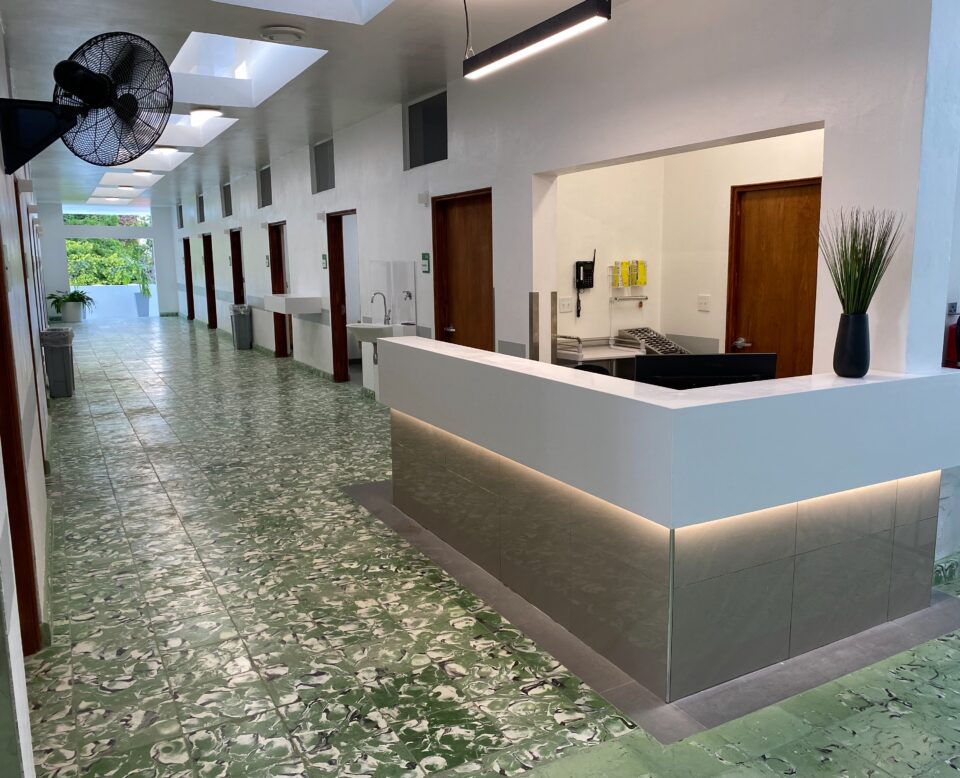
Aug 27 - Today was really a fun day. We had 8 cases scheduled and did them all. Our first case was a lady with a grapefruit sized mass in her left shoulder. It felt like a lipoma. I had Ben do the incision and then he dissected the whole thing out. It was a pretty amazing experience for a college student. He then assisted me on my third ankle fusion this week. It went well. He put in a couple of the screws. Our last case was a wrist fusion. He put in most of the screws. He did really well. He has very steady hands. Todd did 2 more arthroscopies and Ed scrubbed on them both and actually did the second one. He is totally wired about the experience. Our work here at the hospital is over for the week. It has been a very worthwhile experience for all of us.Scott’s wealthy Haitian friend, Jean Marc, came to HAH today and brought some construction people. They looked at the new wing project and the OR and agree completely with Scott and me that it should be finished to appeal to the wealthy. It would include putting in a more appealing tile. They did all of the very nice work on Jean Marc’s home that Scott has visited. It would be great to have it finished to really have high end appeal. We can offer services to the well to do and the income could subsidize care for the poor. Scott thinks that the necessary money would be relatively easy to raise. They are going to give us an estimate by Monday. I’m going to have Scott take them over to the house across the street and have them also give us some ideas about how to make it more livable.

Tuesday, August 31, 2010

Good Things Are Happening

Scott Nelson is on his way stateside after spending almost two weeks back at Hopital Adventiste. I received the following brief email from from him early this morning and he sounds encouraged. Stay tuned for a more detailed trip report from Terry Dietrich that I will post tomorrow.
Short and sweet – it is 1 am. The C-arm is now working!! Hard drive replaced. It was a really good week here. Good things are happening and a lot more good things seem to be just an arm reach away…

Sunday, August 29, 2010

Team Sinai - Mission Report June 2010


The following review is authored by Hopital Adventiste volunteer John Herzenberg, MD, Director of the acclaimed International Center  for Limb Lengthening in Baltimore, Maryland.  You are invited to read more about their experiences on the Team Sinai Haiti Blog.
Team Sinai spent one week at HAH (June 10-17, 2010). We were an 18 person team, primarily from Sinai Hospital of Baltimore. This report is based on our experience there. During that week, our team included one orthopaedic surgeon, two orthopaedic fellows, one podiatry resident, one anesthesiologist, one family practitioner, one physical therapist, six nurses, one prosthetist, one central strerile tech, and three helpers. We worked closely with Dr. Scott Nelson, Orthopaedic Director of HAH. We also “drafted” several volunteers from other teams to work with us (Loma Linda residents, medical students, and nurses from an Oregon team that overlapped our stay). We performed 54 surgeries, and operated past midnight on four out of seven nights. Thirty-one cases had anesthesia by our team anesthesiologist, the remaining twenty-three had anesthesia administered by three Haitian anesthesiologists. We worked hard to accommodate both the elective cases that had been prepared for us, as well as the emergency and urgent cases that were brought in. Examples of cases we performed: hemiarthroplasties for hip fractures, pinning of hip fractures, osteotomies for femoral neck non-unions, SIGN nailing for tibial and femoral fractures, SIGN nailing for nonunions, posterolateral bone grafting for tibial nonunion, plating of femur fractures, ORIF ankle fracture, 8-plates for tibia vara, release of knee/ankle contractures, many clubfoot surgeries, CP tendon lengthening, Fassier Duval nailing for Osteogenesis Imperfecta saber shins, I&D of abscesses, VAC changes, amputations, bone transport for tibial defect (Ilizarov), open reduction of neglected shoulder and hip dislocations (from the January 12 earthquake) and iliac crest bone grafting for various nonunions. In addition, we staffed an orthopaedic clinic on three days, and a Ponseti clubfoot clinic on one day. Average orthopaedic in-patient census was 45. About 50% of patients we operated were below age 21. One third of our cases were earthquake related.
HAH was a 70-bed hospital where not much orthopedic surgery was done before the January 12, 2010 earthquake. It is one of the only hospitals in PAP that survived intact after the earthquake. There is only one thin crack in the structure, and it has been certified by the Army Corps of Engineers as safe and in no need of repair. We were told that the original architect/engineer who designed and built HAH was from California, and that he built it to withstand earthquakes. Immediately after the earthquake, nobody wanted to enter any building in PAP, fearing the aftershocks would cause more damage. Thus, for a short period of time after January 12, 2010, operations at HAH were being performed in tents in the parking lot. Dr. Scott Nelson came to HAH shortly after the earthquake, and stayed for 5 months until June 20, 2010. During those five months, he and others did a tremendous amount of organizational work, and developed one of the most active and advanced orthopedic services in PAP. During the week that we were there, many patients were transferred from other medical facilities (such as MSF and Medishare) to HAH with complex orthopedic injuries, including hip fractures and spinal fractures. Drs. Richard Schwende and Kaye Wilkins were commissioned by the Pediatric Orthopaedic Society of North America to survey potential sites in Haiti for POSNA members to staff, and wrote that based on their survey in late March 2010 that “HAH was the best-equipped and administratively managed hospital among those visited”. http://www.posna.org/news/Haiti_Apr8Update.pdf
Physical plant
HAH is in the Carrefour district of PAP, and is about ¼ mile from the Adventist University. It is about one hour’s drive from the PAP airport, in a mixed residential/commercial neighborhood. There are nearby markets and stores within a few blocks from the hospital. The entire hospital compound is protected by a wall, and has a guarded gate entrance. HAH is a two story concrete hospital, with attached chapel. There is no elevator to the second floor, but there is a covered circular ramp, so that patients could be wheeled on gurneys to the second floor. The first floor contains the ER, OR, pre and post-op wards, radiology department, pharmacy, cast room, clinic, and administrative offices. The second floor has numerous private rooms (one patient per room), numbering about 24, and more administrative offices, and a volunteer’s break room. Air conditioning is present in the three OR’s, break room, cast room, and clinic room. There is a separate, adjacent pediatric ward and OBGYN ward in front of the hospital, about 50 feet away. There are several donated large military style tents on the hospital grounds that are used as step-down units, and there are also numerous small tents on the hospital grounds where many ex-patients and Haitian staff (translators, for example) are staying.
HAH has its own water supply piped directly from a nearby spring. This reliable water supply was actually developed after the earthquake. There is also an onsite purification unit for drinking water. Two generators on site provide back up power if the city grid goes down (almost a daily occurrence). There is good cell phone reception and the hospital has free Wi-Fi available. Due to generator issues, we did have to operate several times in the evenings briefly by lantern/head lamps. In the basement, there is a hospital kitchen that provides one meal daily to patients and volunteers.
The majority of the ex-pat volunteers sleep in a breezy, covered veranda on army cots and under mosquito nets. A few intrepid volunteers pitched tents on the roof of the hospital. Some volunteers stay in the unused private rooms. There is a sufficient number of flush toilets and cold showers available for the volunteers to be comfortable. One meal per day (lunch) is provided by the hospital for patients and volunteers. In keeping with Adventist tradition, the kitchen is strictly vegetarian. Volunteers also bring their own food, which can be prepared in the adjacent air-conditioned volunteer break room, which is equipped with dining tables and a microwave oven. Hospital housekeeping provides dishwashing service. The volunteer sleeping area and break room are guarded 24 hours/day to discourage theft. We never encountered any problems in this area.
Staff
There is a full time Medial Director, Dr. Lesly Archer, who is a Haitian OBGYN. He trained in Montreal, and maintains residences in both Canada and Haiti, but has been continuously present in Haiti since the earthquake. He is charming, trilingual (English, French, and Creole) and was very helpful. They have about three obstetric deliveries per day at HAH, which take place in a separate, adjacent OR facility that I did not see. Dr. Archer does elective OBGYN cases in the main OR facility.
Until recently, Dr. Scott Nelson was the Orthopedic Director, but he left on June 20. Dr. Terry Dietrich of Appleton, Wisconsin tj.dietrich99@gmail.com, is his replacement, but is not due to arrive until November 2010. Dr. Dietrich has served as a volunteer with Dr. Nelson at HAH previously, so he is familiar with the system. For the four month interval until Dr. Dietrich arrives, HAH is relying on part time and short term orthopaedic volunteers, including Dr. Mark Perlmutter, an orthopedic hand surgeon from Pennsylvania, Dr. Barbara Minkowitz, a pediatric orthopedist from New York, and Dr. Karl Rathjens, pediatric orthopedist from Dallas, Texas. A team from New York Columbia Presbyterian is also scheduled to arrive in November. Dr. Lars Hansen, president of the Haitian Orthopaedic and Trauma Association, visited us but we did not see Haitian orthopaedic surgeons operating at HAH.
There are three Haitian anesthesiologists, but their schedules require coordination, and they are generally not available after hours.
The wards are staffed by Haitian nurses, but due to the large volume of patients, dressing changes, and complex problems, it is highly recommended to have a full cadre of volunteer nurses. There is an ex-pat nurse, Brooke Beck (brooke.bbeck@gmail.com) who has been working for the past four months. She coordinates many patient care aspects as well as coordinates the volunteers. She is scheduled to rotate out of HAH in September, and work with another NGO in Haiti. A new expatriate nurse, Jessica Scott has arrived, and will be staying for the foreseeable future. There is also a Haitian American floor nurse coming this fall, which should be a great help in keeping the hospital running efficiently.
The OR has Haitian orderlies, and central sterile personnel for decontamination and instrument sterilization. There are Haitian radiology technologists in the x-ray department.
Haitian doctors staff the ER and peds ward. Many volunteer groups have augmented the Haitians with US family practice or ER docs.
Numerous volunteer translators are ever present to help the teams. While French is spoken widely by the educated class, including nurses and doctors, most of the patients speak only Creole. It is customary for the international volunteers to provide a gratuity to the Haitian translators before departing. Such tips are greatly appreciated by the translators, and other local personnel, many of whom are working for free, and truly depend on the generosity of the international volunteers.
Early on after the earthquake, there was a full time ex-pat relief administrator, Dr. Andrew Haglund, who helped coordinate the reconstruction efforts at HAH. He left about two months ago, and is sorely missed. Recently (late June), a full time ex-pat assistant administrative director has arrived, Nathan Lindsey nlindsey@llu.edu mobile +509-3491-6539 along with his wife, Amy, a nurse. They will be staying for an extended tour of duty. This should be a great help to further develop the long term viability and growth of the HAH. The challenge for volunteers, both long term and short term, is to scrupiously respect the feelings and sensibilities of the Haitian indigenous personnel, encourage them to become invested in the workings of the hospital, and ultimately become sustainable rather than dependent on expatriates.
Affiliation with Loma Linda University (California)
HAH is affiliated with the worldwide network of Adventist Hospitals. HAH has a special relationship with Loma Linda University’s Global Health Initiative. They are also partnering with CURE.
Coordination of volunteers since the earthquake has been through LLU. The contact person at LLU is Alex Sokolov asokolov@llu.edu
At any given time, there are 25-35 volunteers working at HAH. Some groups also have ventured out to staff clinics in the refugee camps and tent cities.
The hospital is affiliated with the Seventh Day Adventist church, so the Sabbath is celebrated on Saturday not Sunday. The OR’s and clinic are closed on Saturday, except for emergencies. Sunday is a regular OR day. Scott Nelson started each day with a 6:30 inspirational meeting on the steps of the hospital. This time was used to read some inspirational passages from sources such as Mother Teresa, to relate stories about what it was like after the earthquake, and to discuss organizational issues. It was conducted in a culturally sensitive, non-denominational fashion, which was important for our team, which included many orthodox Jews.
OR facilities
The OR suite at HAH comprises two large OR’s and one small one. There is a changing room, toilet, large well-organized storage room for orthopaedic sets, a small storage room for sterilized sets, refrigerator (used for blood, drugs that require refrigeration, and drinks), and large central sterile room with two large sterilizer units that can handle any large tray. Between the two large OR’s, there is a small pharmacy storage area. There is not a specific room in the OR that would handle the volume of equipment that Rainbow brings, but there are one or two rooms just outside the OR suite doors that could potentially be used for this. The large OR’s can accommodate any big case, including use of the c-arm. The small room is appropriate for simple cases.
There is a modern c-arm (OEC 9600) with a double monitor and printer. This can be wheeled from room to room. There is a plethora of orthopaedic gear including the following: Synthes large and small fragment sets, cannulated screw sets, Synthes battery powered drills, external fixator sets (Orthofix, Synthes, Hoffman, and Taylor Spatial Frame), hemiarthroplasty set and implants, SIGN nail set and a pedicle screw set for posterior spinal fusion. There are also many surgical instrumentation trays available that are appropriate for orthopaedic cases. There are many wound VAC machines, and a modest supply of consumables for the VAC’s. Suction and Bovie electrocautery were available in each room. For tourniquets, we used Esmarch bandages, and also brought a supply of Hemaclear disposable tourniquets.
Anesthesia facilities
The anesthesia machines and monitoring machines in the OR were old, and only partly reliable. Oxygen was readily available in the OR from tanks, and these could be transferred to the floor if needed. This is similar to what we have encountered on previous missions to Nicaragua and Ecuador. The Haitian anesthesiologists favored spinals over general, and used Ketamine liberally. It is highly advisable to bring a Propack and i-stat. Laboratory facilities at HAH are rudimentary. It was possible to obtain a CBC quickly. We had an i-stat which allowed us to get nearly instant blood work. Microbiology and Blood Bank services are available only off-site. Obtaining blood for transfusion is an ordeal, with the patient’s family having to bring a sample and request to the central Red Cross facility in downtown PAP. Two days is a routine time frame for obtaining blood.
Hospital supplies
There are three fairly cavernous (think last scene of “Raiders of the Lost Ark”) storage rooms which have been well organized and labeled to store the enormous amounts of equipment that was donated after the earthquake. Still, maintaining the supply chain is a challenge, particularly for sterile drapes, gowns, and other OR consumables. We brought a moderate amount of sterile gowns, drapes, towels, lap sponges, and gloves, which came in handy. The hospital routinely washes bloody lap sponges, dries them, and then resterilizes them for re-use.
Orthopaedic Clinic
There is one clinic room and a cast room. Both are air-conditioned. Additional rooms could be made available if needed in the nearby ER suite. There is a digital radiography machine, which stores hundreds of images in its memory. Efforts are being made to obtain hardware that would allow transfer of these images to a PACS. There is also a film radiography machine in the x-ray department, but this was rarely used due to the need to pay for consumables (film and chemicals). Orthopaedic clinic was held three days per week, including one morning of Ponseti clubfoot casting (20 babies). Patients hand-carry their own prior medical records and hard copy radiographs, and are very reliable about bringing them. Most patients have cell phones, so reaching them is not a huge challenge.
Security and Safety
Prior to our mission, there was concern about security and safety issues, based on reports of violence in PAP and kidnapping of MSF workers. Happily, we encountered no problems whatsoever. We felt safe and secure within the HAH compound. We did not experience any episodes of theft or pilfering. The patients and staff at HAH were welcoming and appreciative. Some of our team members ventured on foot a few blocks outside the hospital to purchase soft drinks and fruit at the local market. They reported that the chief safety concern was from road traffic, not people. On two occasions, members of the group went on a supervised walking tour outside the HAH compound to the nearby (1/2 mile) Adventist University site, which has become a tent city. The locals were warm, friendly, and were happy to engage in conversation. Our team included three younger volunteers (age 16-19), and they all had a very positive experience.
No member of Team Sinai became ill during the trip. All were taking malarial prophylaxis. Two members had needle stick exposures, and started taking anti-retrovirals until the HIV test from the involved patients came back negative (24-48 hours later).
Summary
HAH is a very viable site for North American volunteers to consider. It is currently perhaps the most advanced orthopaedic facility in Haiti. The facility is comparable and in some ways superior to other sites in Nicaragua and Equador and Colombia that I have worked at over the past 12 years. There is a generous amount of existing orthopaedic surgery sets and instrumentation, but restocking is a challenge. Teams coming should communicate with the hospital well ahead of time to determine what supplies should be brought down.
Until Dr. Dietrich arrives in November, it will be challenging for teams to get as much accomplished in a short time as we did under the supervision of Dr. Scott Nelson. Nonetheless, the needs are great, and the potential impact that volunteer teams have is tremendous. The local needs are for both pediatric and adult types of cases. Orthopaedic surgeons, nurses and anesthesiologists who go to HAH should be comfortable treating both children and adults. There is much earthquake related trauma sequelae, as well as fresh trauma, and elective pediatric orthopaedics.
Volunteer groups need to partner with Loma Linda University for coordination purposes. LLU is well organized, and even provides malpractice insurance and health insurance to the volunteers. They keep track of various volunteer groups and individuals to insure that there will not be excessive overlap of manpower. Loma Linda does charge each volunteer $15/day to cover the cost of food (one meal/day) and airport transfers.
The Sinai Hospital team had a remarkable and positive experience, and to a man, expressed interest in someday returning. In fact, we are currently making tentative plans to return in December 2010.